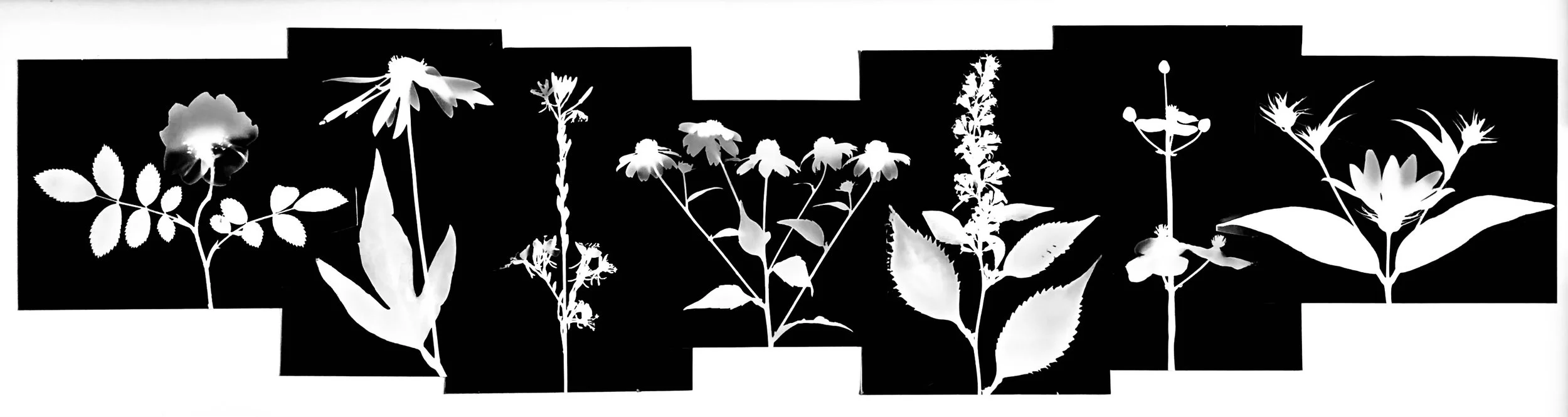
The images on this website are the result of my being an artist and a naturalist, tending a nature preserve at Oakton College in DesPlaines Illinois. The intent is both artistic and educational, showing the character of our native plant species, and serving as a source to ID the plants. Oakton is part of a larger ecological restoration community called The Chicago Wilderness Alliance, consisting of nature preserves around southern Lake Michigan.
I started the restoration process of bringing back native plant species to help heal the land and provide habitat for wildlife on 30 acres of remnant woodland along the Des Plaines River in the late 1980’s, and eventually also turning 5 acres of mowed grass to prairie recreations. During this time, I decided to artistically document the native plants on campus, choosing a technique called a photogram. This allowed plants to be viewed without clutter in only stark blacks, whites and grays, revealing its character.
A photogram is a non camera, darkroom process where light sensitive white photo paper is laid on a platform under a light source, with an object placed on the paper. It is then exposed to light, for in this case 3 to 10 seconds, and run through a series of chemical baths. During the last bath, an image slowly appears. Areas that were not covered by the object will turn black, dense objects, like an acorn that light can not penetrate, will remain white, and translucent objects such as a flower petal, or a thin leaf will come up in various grays. In my case, I laid the flower first on a sheet of glass, which was then placed on the paper. As this species documentation continued (over 200), other uses for these plant parts were added in collages, scenes and abstracts were added.
I did have permission for this project. I have given some of these images to Oakton so far, with plans for more soon. Of the plants I used, a majority were from species that I reintroduced to campus in native gardens and recreations. These were mostly prairie and wetland species. The woodland species were remnant. Of those species that show the roots, some were from pot grown plants and some were dug up. Those that were dug up were successfully replanted.
Bio- I have led a life of mostly art, nature and cats. Grew up in Appleton, Wisconsin with a lot of natural areas to explore with my brothers and other neighbor kids. Graduated from the University of Wisconsin, Oshkosh in studio arts with the emphasis on drawing and print making, and shortly moved to the Chicago area in 1979. I became aware at all of the nature preserves throughout NE Illinois, and started learning about them. I mentored through an organization called The Cook County Forest Preserve District, started around 1920, and a worldwide model for urban restoration. I was a groundskeeper at Oakton at the time, and learned enough to propose to Oakton the start of restoration on campus. It was accepted, and I became the campus naturalist. I am now retired, and thankfully, the work continues.
I have had exhibits at The Notebaert Nature Museum in Chicago, Emily Oaks Nature Center in Skokie, and other venues such as libraries, and have not tried very hard as of yet to be included in places such as galleries.